

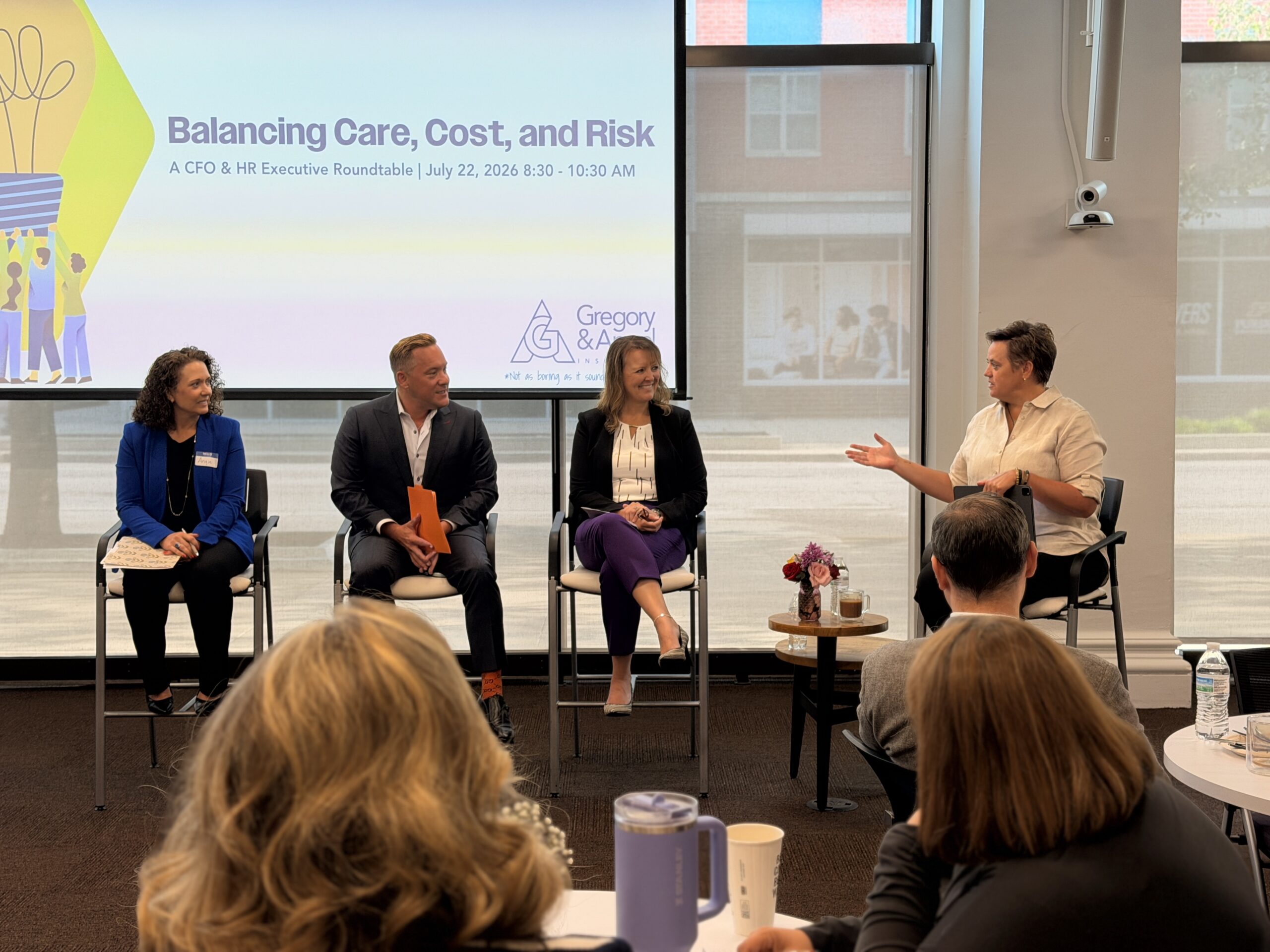
Recently, Gregory & Appel brought local CFOs and HR leaders together for our Balancing Cost, Care, & Risk roundtable. We brought together leaders wrestling with the same fundamental challenge: how do we protect our people without breaking the bank?
Here's what we learned together.
1. Start with Shared Organizational Values
When HR and finance agree on what the organization values as an employer, they can look at investments in the same way. This kind of alignment takes effort and planning.
Angie Woods, our VP of HR, and Sarah Robison, our CFO, started at Gregory & Appel on the same day, which made that alignment a priority from the start. As Angie put it: "The best HR professionals are the ones who, more than just looking through the lens of people, understand the business, understand the findings, understand all of that... we know that the cost of our people are the greatest cost on balance sheet, right? So just having that constant cost trade-offs, and it's a balance."
Sarah added her own perspective on why this matters: "While HR has the full purview of people, finance has the whole purview of the company and where we invest the dollars. And every dollar that's invested in any particular area means it can't be invested somewhere else."
2. Replace an Immediate "No" with a Conversation About Trade-Offs
Think about what the organization could move, delay, or add to a long-term plan instead of seeing every decision as just a yes or no.
"Instead of I try and I'm always great at it, but I try not to always say no," Sarah explained. "It's what's the trade-off? What are we willing to give up? Or what are we willing to shift? Or what are we willing to adjust? Or can it be no for now, and we can put it onto the roadmap to look at in a year? And trying, as much as I can, to bring folks along in those conversations versus just making those decisions and saying this is the way it has to be."
3. Build a Long-Term People Plan Alongside the Financial Plan
Plan out benefit decisions, workforce investments, and key milestones for the next three to five years.
"Just like in finance, we're used to doing budgets or three-to-five-year plans," Sarah said. "There needs to be a three-to-five-year people plan along with it. It's not just the recruiting and the attraction side, but what are the things that we're going to do? What is our benefit planning going to look like? When are we going to make these next decisions? What are the gates or the milestones that need to happen where we can make this next investment, so we all know what we're looking towards."
4. Treat Benefits as an Investment, Not Simply an Expense
Healthcare costs will likely keep rising, so the goal is to slow that growth and make sure both employees and the organization get more value.
"While we like to say we want to reduce or lower healthcare costs, the reality is they very rarely ever go down," Sarah said. "But it's how can we slow the increase? How can we get the value? What can we do on the preventative side? If you look just at the numbers, it's always an expense, but you have to look at it as an investment in our people and all the other aspects that go with it."
5. Use Benchmarking Selectively
Big reports can be overwhelming. Focus on data from similar industries, company sizes, and workforce groups, and look for plan features that matter most for hiring and keeping employees.
Matt Heincker, our Employee Benefits Practice Leader, explained how G&A approaches this with clients: "There are certain areas of your plan that are pretty important if they're in line with your competitors—just basic plan design. But things like PTO, mental health services, there are a lot of ancillary things that are becoming a lot more important. The younger generation really values their lifestyle. So there's specific parts of this 40-page report we're going to really direct your attention to."
Angie described how she narrows the data down internally: "I want to get as close to apples-to-apples as possible. So looking at certain things in our industry—what are our competitors doing, organizations that are similar in our size, headcount, revenue, geographical differences... We're not benchmarking against the Googles and the Metas, because we're not them. We're a smaller company."
6. Listen to Employees Before Investing
Surveys and feedback show which benefits employees actually value. This helps organizations avoid spending on programs that people rarely use.
"I love doing surveys," Angie said. "The last thing I want to do is spend money on a benefit that we think people find important and they don't. And so we want that information so that we can make some trade-offs—so we can invest that money somewhere else for a benefit that we don't have that is important to our employees."
Sarah pointed to a related discipline: tracking utilization after the fact. "With some of our benefits, we actually get utilization reports to be able to understand: is it driving what we're looking for? There's been a couple of items here at G&A when Angie and I came in, and utilization's high... we're like, how can we redeploy those dollars?"
7. Account for the Work Behind Cost-Containment Strategies
Many strategies mean employees have to change how they use their benefits. Think about the training, communication, and support needed to help them adjust.
"There are a lot of things that are effective," Matt said of cost-containment strategies. "But what comes with it is employee education. Most of them require education with your employees to relearn how to interact with their benefits and how to access them. So what is your appetite for that? And what's your organization's bandwidth for that?"
8. Evaluate the Support Behind Your Benefits Strategy
Your broker or benefits advisor should offer more than just renewal numbers. Find a partner who provides useful benchmarking, explains the pros and cons of different strategies, helps share changes with employees, and ties benefit decisions to your bigger business goals.
Matt described how this plays out in practice: "We really rely on a lot of benchmarking because your benefits need to look very different depending on what industry you are in to be an employer of choice... So we show you what that looks like for your industry—maybe there's some small tweaks you can make that really elevate it quite a bit, but don't cost a lot. And the second part of that is really: what are the most effective ways to contain cost? We've got our finger on the pulse of the more innovative strategies to contain cost."
The Path Forward
The best benefits strategies balance financial responsibility with what employees really need. This takes teamwork, good data, and regular conversations between HR, finance, and leadership.
Ready to align your people strategy with your bottom line? Reach out to our Employee Benefits team for a one-on-one strategy session to review your current benefits, benchmark against your industry, and explore innovative cost-containment options.